Common Eye Defects & Best Glasses Guide (2026)
May 5, 2026
By Rahul Jain
0 comment(s)
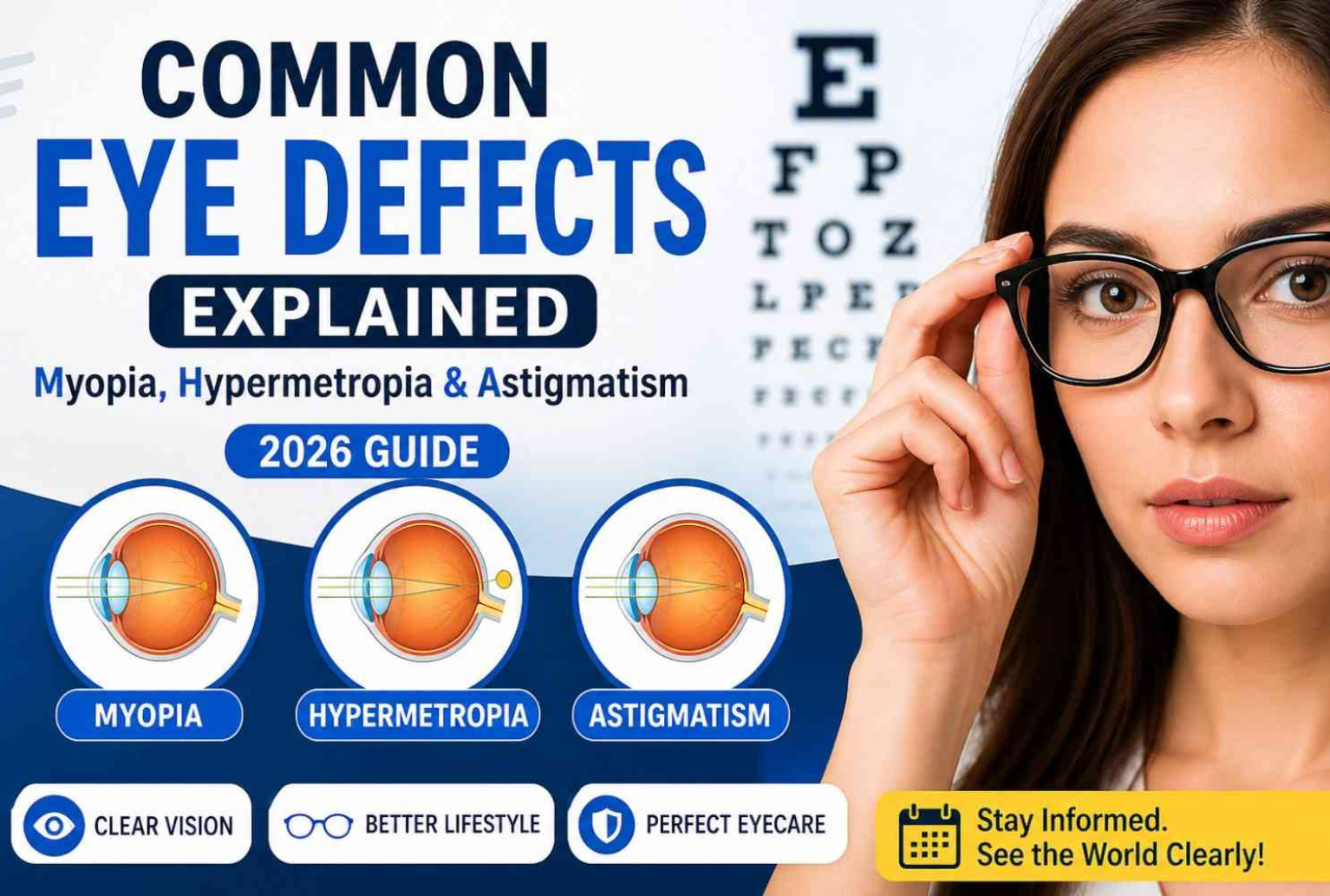
Common Eye Defects Explained
Myopia, Hypermetropia & Astigmatism — The Ultimate 2026 Vision Guide
Introduction
Vision is one of the most important senses in our daily life, yet it is often neglected until problems begin to appear. With the rapid rise in digital screen usage, unhealthy lifestyle habits, and increasing environmental stress, eye defects are becoming more common than ever before.
In this comprehensive guide, we will explore the three most common eye defects — myopia, hypermetropia, and astigmatism — in depth. You will learn their causes, symptoms, diagnosis, and the best modern solutions available in 2026.
Global Insight: By 2050, nearly half the world population is expected to suffer from myopia.
What Are Eye Defects?
Eye defects occur when the light entering the eye does not properly focus on the retina. This results in blurred or distorted vision. The main reason behind this improper focusing is the shape of the eyeball or irregularities in the cornea.
These defects can be inherited genetically or can develop over time due to lifestyle habits such as prolonged screen exposure, lack of sleep, and improper lighting conditions.
Types of Common Eye Defects
Myopia (Nearsightedness)
Myopia is a condition where nearby objects appear clear, but distant objects look blurred.
- Caused by elongated eyeball
- Common in students & professionals
- Increasing due to mobile usage
Correction: Concave lenses
Hypermetropia (Farsightedness)
Hypermetropia makes it difficult to see nearby objects clearly.
- Short eyeball
- Common in adults
- Reading difficulty
Correction: Convex lenses
Astigmatism
This defect causes distorted vision due to uneven curvature of the cornea.
- Blur at all distances
- Headaches
- Eye strain
Correction: Cylindrical lenses
Detailed Explanation of Each Eye Defect
Myopia in Detail
Myopia is becoming one of the fastest-growing eye problems in modern society. Continuous exposure to screens forces the eyes to focus on close objects for extended periods, which leads to elongation of the eyeball.
Modern eyewear solutions now include blue light filtering lenses, anti-reflective coatings, and lightweight frames for better comfort.
Hypermetropia in Detail
Hypermetropia usually develops with age as the eye loses its focusing ability. Reading glasses or progressive lenses are commonly recommended for smooth transition between distances.
Astigmatism in Detail
Astigmatism often occurs along with myopia or hypermetropia. Advanced lens technology helps provide clear vision without distortion.
Comparison Table
| Condition | Vision Problem | Cause | Lens Type |
|---|---|---|---|
| Myopia | Far objects blurry | Elongated eyeball | Concave |
| Hypermetropia | Near objects blurry | Short eyeball | Convex |
| Astigmatism | Distorted vision | Irregular cornea | Cylindrical |
Impact of Digital Lifestyle
In 2026, digital eye strain has become a major concern. Prolonged screen usage leads to dryness, blurred vision, and worsening of existing eye defects.
- Reduced blinking
- Blue light exposure
- Improper posture
Follow the 20-20-20 rule to reduce strain.
How to Choose the Right Glasses
Choosing the right glasses is not just about vision correction, but also about comfort, style, and protection.
- Use accurate prescription
- Choose anti-glare lenses
- Use blue light protection
- Select frames based on face shape
Upgrade Your Vision Today
Explore premium eyewear designed for every vision need.
Shop Prescription GlassesExclusive Offers
Sitewide
33%
OFF
Flat 33% off on all products
Already applied on every price · no coupon needed
Auto-applied
10%
OFF
On orders ₹1,200 – ₹1,799
No coupon needed · saves automatically
Auto-applied
15%
OFF
On orders ₹1,800 – ₹3,199
No coupon needed · saves automatically
Best Deal 🔥
20%
OFF
On orders above ₹3,200
No coupon needed · saves automatically
Pay Advance
₹50
SAVED
Pay advance amount at checkout
Flat ₹50 off · pay balance on delivery
Pay Full ✓
₹100
SAVED
Pay full amount at checkout
Maximum saving · instant confirmation
N
Nations Optics Assistant
● Online
👋 Hi! I'm your Nations Optics assistant. Ask me anything about lenses, frames, or prescriptions!