
Acetate vs Carbon Fiber vs Titanium Frames: Care Guide | Nations Optics
Apr 29, 2026
By Rahul Jain
0 comment(s)
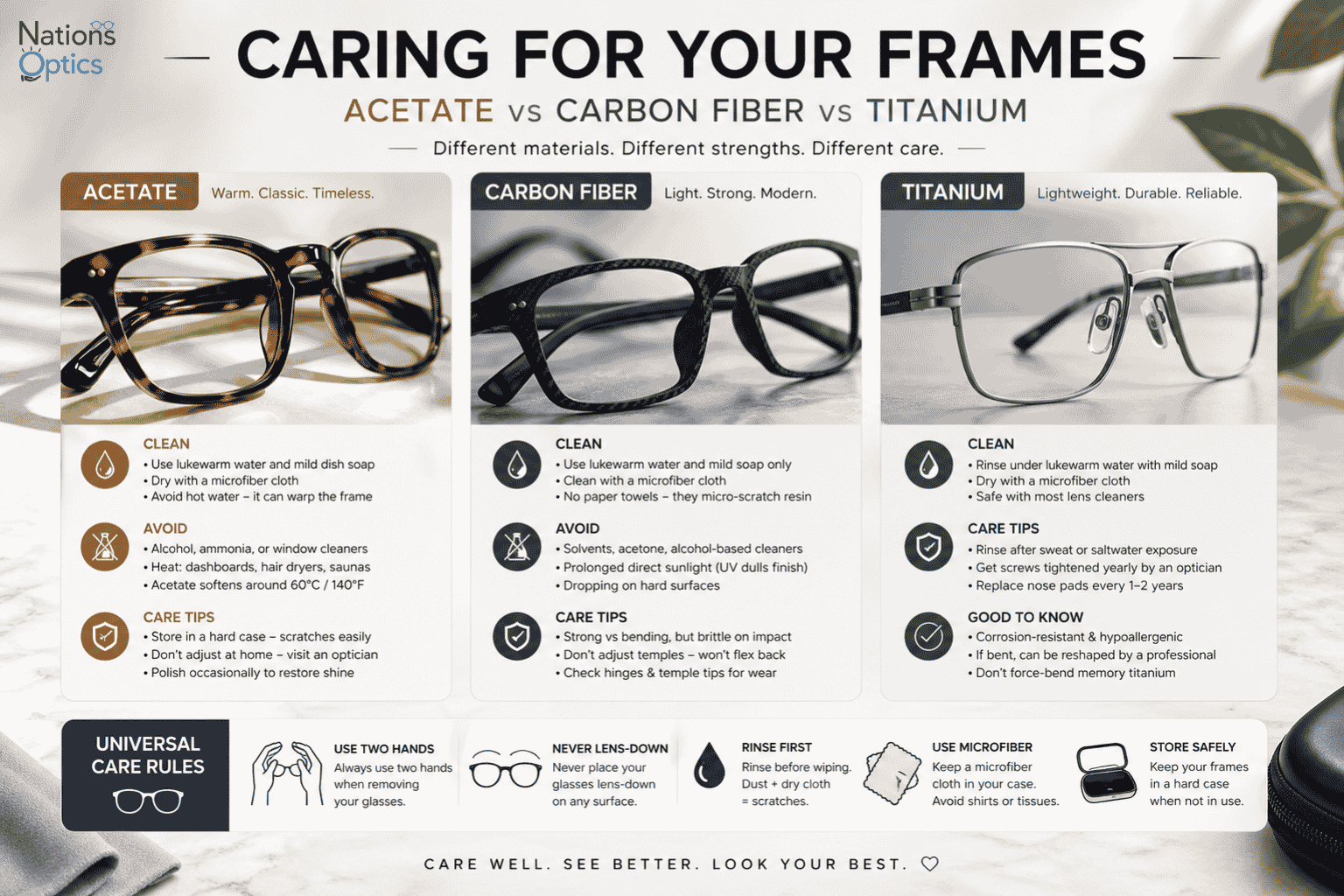
Caring for Acetate vs Carbon Fiber vs Titanium Frames: The Complete Guide
Your glasses are an everyday investment. Each frame material has its own strengths, weaknesses, and care routine — knowing the difference can add years to your eyewear's life.
Not all eyeglass frames are built the same. Acetate offers warmth and rich color depth, carbon fiber delivers featherweight strength, and titanium provides unmatched durability. But the same cleaning habits won't work for all three. This guide breaks down exactly how to clean, store, and protect each material — so your frames look as good in year five as they did on day one.
Quick Comparison at a Glance
Before we dive into the details, here's how the three materials stack up against each other.
| Feature | Acetate | Carbon Fiber | Titanium |
|---|---|---|---|
| Weight | Medium | Ultra-light | Very light |
| Durability | Moderate | High (brittle to impact) | Excellent |
| Heat Resistance | Low | High | Very High |
| Hypoallergenic | Yes | Yes | Yes |
| Maintenance | Moderate | Careful | Easy |
| Best For | Bold style & color | Sport & lightweight wear | Daily, long-term use |
Acetate Frames
Plant-Based Rich Colors Heat-SensitiveAcetate is a plant-based plastic made from cotton and wood pulp, prized for its depth of color, layered patterns, and warm feel against the skin. It's the material of choice for tortoiseshell, translucent crystal, and bold statement frames. The trade-off: it softens under heat and reacts to harsh chemicals, so it needs a gentler care routine than metal frames.
Cleaning
- Rinse under lukewarm water with a drop of mild dish soap
- Pat dry with a clean microfiber cloth — never paper towels
- Avoid hot water; acetate softens around 60°C / 140°F and can warp
What to Avoid
- Alcohol, ammonia, acetone, and household window cleaners — they strip the polish and dull the finish
- Leaving frames in hot cars, near hair dryers, or in saunas
- Sleeping in your glasses, which can permanently bend the bridge
Care Tips
- Always store in a hard case — acetate scratches and dents more easily than metal
- If frames feel loose, visit an optician; they use controlled heat to safely re-tighten
- Apply a small amount of frame wax or acetate polish every few months to keep darker tortoiseshell finishes glossy
- Rotate between two pairs if possible — acetate benefits from "rest" periods to recover its shape
Did you know? Premium acetate is made in sheets and aged for weeks before being cut into frames — that's what gives it the deep, marbled patterns you can't replicate with cheaper injection-molded plastic.
Shop Acetate Frames →Carbon Fiber Frames
Ultra-Lightweight High-Tech PerformanceCarbon fiber frames are made from woven carbon strands bonded with resin. The result is incredibly light yet rigid — perfect for sport, travel, and minimalist designs. The catch is that carbon doesn't flex like metal; it resists bending beautifully but can crack under sharp impact. The resin coating also reacts poorly to solvents.
Cleaning
- Use lukewarm water with a tiny amount of mild soap
- Wipe with a microfiber cloth, never paper or rough fabric
- Air dry briefly before placing in a case to prevent moisture trapping at hinge joints
What to Avoid
- Solvents, acetone, and alcohol-based cleaners — they dissolve the resin matrix
- Paper towels and tissues, which cause micro-scratches in the glossy finish
- Prolonged direct sunlight, which can slowly dull the surface over years
Care Tips
- Treat carbon like a high-performance bicycle — it's strong, but a hard drop can crack it where titanium would bend
- Never try to adjust temple arms yourself; carbon doesn't reshape and may snap
- Inspect metal hinges and acetate tips separately, since these are the typical wear points
- If you notice resin chipping or whitening, take the frame to an optician promptly — early repairs are sometimes possible
Pro insight: Carbon fiber is up to 5x stronger than steel by weight, but its real advantage in eyewear is rigidity — frames hold their shape on your face all day without slipping.
Shop Carbon Fiber Frames →Titanium Frames
Hypoallergenic Corrosion-Proof Long-LastingTitanium is the gold standard for everyday durability. It's lightweight, flexible, hypoallergenic, and resistant to sweat, saltwater, and corrosion — making it the easiest material to live with. Memory titanium variants can even bend significantly and snap back to shape. For people who travel, work outdoors, or simply want a frame that lasts a decade, titanium is hard to beat.
Cleaning
- Rinse under lukewarm water with a drop of mild soap
- Dry with a microfiber cloth — pay attention to nose pads and hinge crevices
- Most lens-cleaning sprays are safe, but skip harsh ammonia formulas to protect any lens coatings
What to Avoid
- Force-bending the temples yourself — even flexible titanium needs proper technique
- Leaving frames in concentrated chlorinated water (pools) for long periods
- Letting old, hardened nose pads dig into your skin — they're cheap to replace
Care Tips
- Rinse after ocean swims, heavy sweating, or sunscreen exposure to keep nose pads and screws clean
- Visit an optician once a year for a free hinge tightening and alignment check
- Replace silicone nose pads every 12–18 months; they yellow and harden with skin oils
- If bent, take it to a professional — titanium reshapes well, but only with the right tools
Why titanium? The same material used in aerospace and surgical implants makes its way into eyewear for a reason — it's biocompatible, meaning even sensitive skin types rarely react to it.
Shop Titanium Frames →Universal Care Rules (For Every Frame)
No matter what your frames are made of, these habits will extend their life dramatically:
- Always remove glasses with both hands — single-handed pulling stretches hinges over time on every material
- Never place glasses lens-down on any surface — even soft cloth can scratch coatings
- Rinse before wiping — dust plus a dry cloth is the #1 cause of lens scratches
- Skip the shirt hem and tissues — fabric fibers and wood pulp are abrasive at a microscopic level
- Keep a microfiber cloth in your case and wash it monthly with mild soap
- Don't leave frames in hot cars — interior temps regularly exceed 70°C / 160°F in summer
- Get a professional check-up yearly — most opticians do free adjustments and screw tightening
Frequently Asked Questions
How often should I clean my glasses?
Daily for lenses, weekly for a full frame wash. Rinse them in the morning before wearing — this removes overnight dust and oil buildup.
Can I use lens-cleaning wipes on my frame material?
Yes for titanium, with caution for acetate, and never for carbon fiber. The alcohol content in pre-moistened wipes can degrade acetate polish and carbon resin over time.
Which material lasts the longest?
Titanium, by a wide margin. With basic care, titanium frames can easily last 8–10+ years. Acetate typically lasts 3–5 years, and carbon fiber 4–6 years depending on use.
Are these materials safe for sensitive skin?
All three are hypoallergenic, but titanium is the safest choice for highly reactive skin since it's used in medical implants. Avoid frames with nickel-plated metal components if you have allergies.
Can I shower or swim in my glasses?
Avoid both. Hot shower steam can warp acetate, chlorine can corrode metal screws, and saltwater leaves residue on every material. If exposure happens, rinse and dry thoroughly.
Discover Premium Eyewear at Nations Optics
From handcrafted acetate to lightweight titanium and high-performance carbon fiber — find frames built to last, designed for everyday comfort.
Shop Acetate Shop Carbon Fiber Shop TitaniumExclusive Offers
Sitewide
33%
OFF
Flat 33% off on all products
Already applied on every price · no coupon needed
Auto-applied
10%
OFF
On orders ₹1,200 – ₹1,799
No coupon needed · saves automatically
Auto-applied
15%
OFF
On orders ₹1,800 – ₹3,199
No coupon needed · saves automatically
Best Deal 🔥
20%
OFF
On orders above ₹3,200
No coupon needed · saves automatically
Pay Advance
₹50
SAVED
Pay advance amount at checkout
Flat ₹50 off · pay balance on delivery
Pay Full ✓
₹100
SAVED
Pay full amount at checkout
Maximum saving · instant confirmation
N
Nations Optics Assistant
● Online
👋 Hi! I'm your Nations Optics assistant. Ask me anything about lenses, frames, or prescriptions!