How to Read Eye Prescription: SPH, CYL, AXIS & ADD | NationsOptics
Mar 16, 2026
By Rahul Jain
0 comment(s)
How to Read Your Eye Prescription — SPH, CYL, AXIS & ADD Explained
You just came back from your eye test and the doctor handed you a small slip with numbers like ±2.00, ±0.75, 180° and +1.50. Most people stare at it blankly and hand it straight to the nearest optical shop without understanding a single value. That ends today — certified optician Rahul Jain breaks down every value in plain, simple language.
At NationsOptics, our certified optician Rahul Jain has been reading and fitting prescriptions for over 35 years. In this complete guide, he breaks down every single value on your eye prescription in plain language — so you can understand exactly what your eyes need and order your glasses online with total confidence.
Whether you are buying glasses for the first time or upgrading after years, this guide covers everything — SPH, CYL, AXIS, ADD and PD — with real examples so nothing is left unclear.
What Does an Eye Prescription Look Like?
A standard Indian eye prescription has two rows — one for each eye:
- RE / R/E / OD = Right Eye (OD from Latin Oculus Dexter)
- LE / L/E / OS = Left Eye (OS from Latin Oculus Sinister)
Each row has columns for SPH, CYL, AXIS, and sometimes ADD and PD. Some prescriptions also show VA (visual acuity) and Dist/Near rows. Let us go through each value clearly.
SPH — Spherical Power
SPH
What is SPH?
SPH stands for Spherical power. It is the most fundamental value in your prescription — the basic strength your lens needs to correct your vision for distance or near.
What does plus or minus mean?
A minus (−) sign means you are short-sighted, also called myopia. You can see things up close clearly but distant objects appear blurry — a classroom board, a road sign, or a face across the room.
A plus (+) sign means you are long-sighted, also called hyperopia. You struggle to see things up close clearly — reading a book, using your phone, or looking at a menu.
What does the number mean?
The number tells you the strength of correction needed. ±1.00 is mild. ±4.00 is moderate. ±8.00 and above is high power. The higher the number — whether plus or minus — the stronger the lens required.
At NationsOptics we cover SPH up to ±8.00 — from the mildest correction to high power prescriptions.
In simple terms: SPH is the main engine of your lens. It is present in every single prescription without exception — whether your number is +0.50 or −8.00.
CYL — Cylindrical Power
CYL
What is CYL?
CYL stands for Cylindrical power. It corrects a condition called astigmatism — where your eye is slightly oval or irregular in shape instead of perfectly round. This causes blurred, distorted or shadowed vision at any distance — not just far or near.
Does everyone have CYL?
No. If your prescription shows 0.00 or a blank in the CYL column, it simply means you do not have astigmatism. Many people have SPH correction without any CYL at all.
Plus or minus CYL?
Like SPH, CYL carries either a minus (−) or plus (+) sign depending on the format your doctor uses. Some doctors write CYL in minus notation, others in plus. Both are valid — your optician converts between formats when cutting the lens.
At NationsOptics we cover CYL up to ±4.00 — covering mild, moderate and high astigmatism prescriptions.
In simple terms: CYL fixes the blur caused by an irregularly shaped eye. If it is 0.00, you have no astigmatism. If it has a value, it must be incorporated into your lens for clear vision.
AXIS — The Direction of Astigmatism
AXIS
What is AXIS?
AXIS is always written alongside CYL. This is the single most important rule about AXIS:
If your CYL is 0.00, there is no AXIS value needed. But the moment CYL appears on your prescription, AXIS must appear with it. A prescription with CYL but no AXIS is incomplete and cannot be used to make accurate lenses.
What does the AXIS number mean?
AXIS is written as a number between 1° and 180°, representing degrees. It tells the lens maker the exact angle at which the cylindrical correction must be placed inside the lens.
Think of it like a compass direction for your eye — your astigmatism runs in a specific direction, and AXIS tells the lab precisely which direction that is, so the corrective curve is placed at exactly the right angle.
Common AXIS values
- AXIS 180° — horizontal astigmatism, one of the most common
- AXIS 90° — vertical astigmatism
- AXIS 45° or 135° — oblique or diagonal astigmatism
In simple terms: AXIS is the directional guide for CYL. Without it, the CYL power would be placed at the wrong angle and your vision would still be blurry. Always ensure both CYL and AXIS are written on your prescription slip.
ADD — Addition Power
ADD
What is ADD?
ADD stands for Addition power. This is the value that confuses most people — because it only appears on certain prescriptions and is often completely misunderstood.
The most important rule about ADD: ADD is prescribed only for people who need multivision lenses — specifically progressive lenses or bifocal lenses. A single vision lens does not use this value at all.
What does ADD represent?
ADD is always a plus (+) value, typically ranging from +0.75 to +3.00. It represents the extra magnification power added to the lower portion of the lens specifically for reading and near work.
Who gets an ADD value?
People above 40 years of age commonly begin experiencing difficulty reading up close — a completely natural condition called presbyopia. The natural lens inside your eye gradually loses its flexibility and can no longer shift focus between near and far distances easily.
When this happens, your doctor prescribes an ADD value. This extra power is built into the lower segment of a progressive or bifocal lens — giving you clear distance vision through the top and clear near vision through the bottom, all within a single pair of glasses.
Types of multivision lenses with ADD
- Progressive lenses — no visible line, seamless natural transition from distance to intermediate to near. Most popular and cosmetically superior.
- Bifocal lenses — a visible dividing line between the distance zone above and the near zone below. More affordable and easier to adapt to for some users.
At NationsOptics we cover ADD up to +3.00 — suitable for mild, moderate and advanced presbyopia.
In simple terms: ADD is the near-reading power built into the bottom of a multivision lens. It only appears when presbyopia is present — typically above age 40. If your prescription has ADD, you need progressive or bifocal lenses. If it does not, single vision lenses are what you need.
PD — Pupillary Distance
PD
What is PD?
PD is the distance in millimetres between the centre of your right pupil and the centre of your left pupil. This measurement ensures the optical centre of each lens lines up precisely with each of your eyes.
Why does PD matter?
Even a perfectly correct prescription will cause discomfort, eyestrain, headaches and blurry vision if the PD is wrong. The optical centre of the lens must sit directly in front of your pupil for your eyes to see through the sharpest part of the lens.
How is PD written?
PD is typically between 58mm and 72mm for adults. It may also be written as two separate numbers — for example 32/31 — representing the right and left eye distances measured independently.
Always provide your PD when ordering glasses online. Ask your optician to measure and include it on your prescription slip. Without it, even the most accurate prescription will not deliver optimal vision.
Your Complete Prescription — Decoded
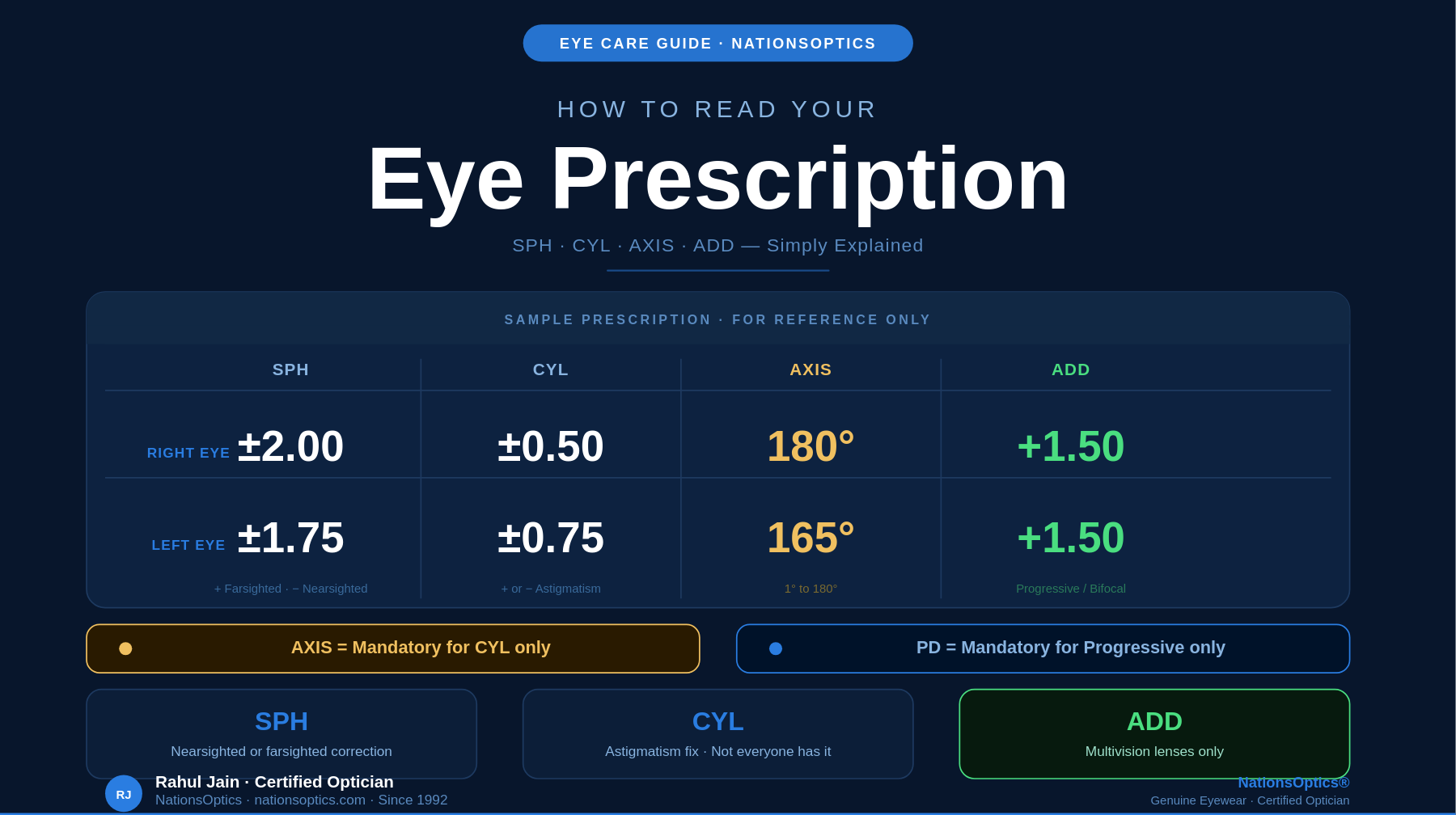
Here is a real sample prescription so everything comes together at a glance:
| SPH | CYL | AXIS | ADD | |
|---|---|---|---|---|
| RIGHT EYE | −2.00 | −0.50 | 180° | +1.50 |
| LEFT EYE | −1.75 | −0.75 | 165° | +1.50 |
| PD | 63 mm | |||
| Both eyes are short-sighted (minus SPH) · Both have astigmatism (CYL + AXIS present) · ADD present = Progressive lenses required | ||||
Quick Reference — All Values at a Glance
SPH
Basic lens power. Plus = farsighted. Minus = nearsighted. Present in every prescription. NationsOptics covers up to ±8.00.
CYL
Astigmatism correction. Plus or minus. Not everyone has it. Zero means no astigmatism. NationsOptics covers up to ±4.00.
AXIS
Direction of CYL. Always 1° to 180°. Mandatory whenever CYL is present. Never appears without CYL.
ADD
Near reading power. Always plus. Only for progressive and bifocal multivision lenses. Appears with presbyopia above age 40. NationsOptics covers up to +3.00.
Remember: AXIS is mandatory for CYL only · PD is mandatory for Progressive lenses · ADD is for Multivision lenses only
Frequently Asked Questions
Can I order glasses online with just my prescription slip?
Yes. At NationsOptics you simply enter your SPH, CYL, AXIS and ADD values along with your PD. Our certified optician Rahul Jain personally verifies every single order before your lenses are cut and fitted.
My prescription has CYL but no AXIS — is it complete?
No. A prescription with CYL must always include AXIS. If your slip is missing AXIS, contact your eye doctor and ask them to add it. An incomplete prescription cannot be used to make accurate glasses.
What if my prescription only has SPH and no CYL?
That means you do not have astigmatism. You only need a spherical single vision lens — the simplest and most affordable option available at NationsOptics starting from ₹499.
What does Plano or PL mean on my prescription?
Plano means zero power for that value. RE: Plano in the SPH column means your right eye needs no spherical correction. CYL: Plano means no astigmatism is present.
What if I do not have an ADD value on my prescription?
It means your doctor has prescribed single vision lenses. ADD only appears when multivision correction is needed — typically for people above 40 with presbyopia. Without ADD, do not order progressive lenses.
What if I do not know my PD?
Ask your optician to measure it during your eye test — it takes under 60 seconds. Some doctors include it on the prescription automatically. You can also visit any optical shop near you for a quick PD measurement.
Does NationsOptics accept high power prescriptions?
Yes. NationsOptics covers SPH up to ±8.00, CYL up to ±4.00 and ADD up to +3.00 — including single vision, progressive, bifocal and zero power lenses across all our frame collections.
How often should I update my prescription?
Adults should get their eyes tested every 1 to 2 years. If you notice increased blurring, headaches, squinting or eye strain before that, visit your eye doctor sooner rather than waiting for your next scheduled test.
Ready to Order Your Glasses?
Now that your prescription makes complete sense, ordering glasses online is simple and stress-free. Every pair at NationsOptics is crafted under the personal supervision of certified optician Rahul Jain — 35+ years of optical excellence behind every order. Genuine frames from ₹499. Free pan-India shipping.
Browse Frames from ₹499 Personalize Your LensesHave a question about your prescription? WhatsApp us at +91 87553-87553 and Rahul Jain will personally guide you to the right glasses for your eyes and lifestyle.
Exclusive Offers
Sitewide
33%
OFF
Flat 33% off on all products
Already applied on every price · no coupon needed
Auto-applied
10%
OFF
On orders ₹1,200 – ₹1,799
No coupon needed · saves automatically
Auto-applied
15%
OFF
On orders ₹1,800 – ₹3,199
No coupon needed · saves automatically
Best Deal 🔥
20%
OFF
On orders above ₹3,200
No coupon needed · saves automatically
Pay Advance
₹50
SAVED
Pay advance amount at checkout
Flat ₹50 off · pay balance on delivery
Pay Full ✓
₹100
SAVED
Pay full amount at checkout
Maximum saving · instant confirmation
N
Nations Optics Assistant
● Online
👋 Hi! I'm your Nations Optics assistant. Ask me anything about lenses, frames, or prescriptions!