
How to Read an Eye Prescription – Step-by-Step Guide | NationsOptics
Apr 11, 2026
By Rahul Jain
0 comment(s)
Buying Guide
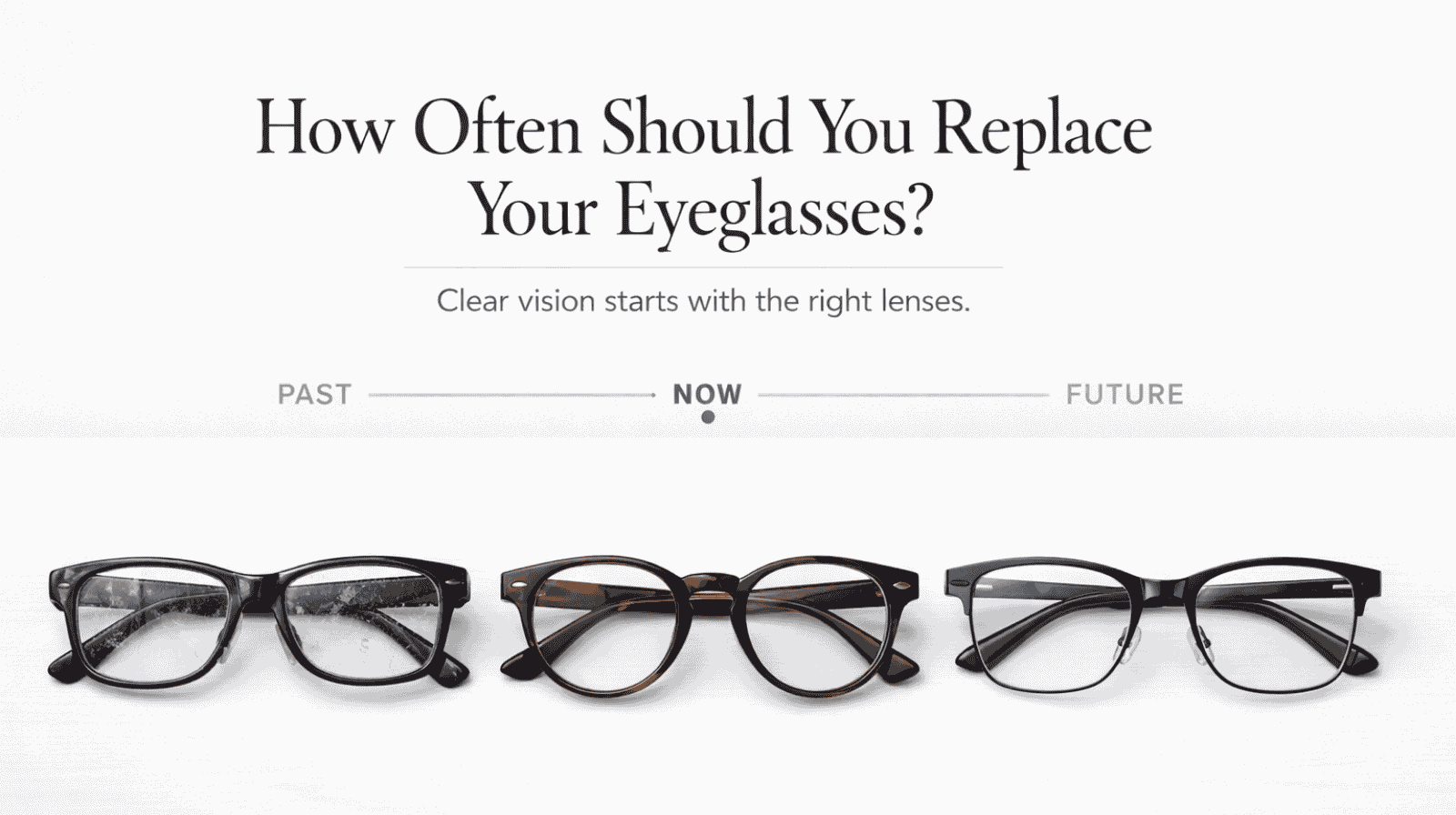
How Often Should You Replace
How Often Should You Replace
Your Eyeglasses?
Most people treat glasses like appliances — replacing them only when they break or become unwearable. But your eyes and your lenses change over time, and waiting too long can mean you're looking through scratched, outdated, or poorly fitting eyewear every single day. This guide tells you exactly when to replace your glasses — and why.
Prescription
12–24 mo
Most prescriptions should be re-checked annually or every two years.
Lenses
2–3 yrs
Coatings degrade; scratches accumulate on even premium lenses.
Frames
2–4 yrs
Metal fatigue, hinge wear, and fit changes affect comfort over time.
1. Lens Life: How Long Do Eyeglass Lenses Last?
The optical clarity of a lens can remain technically intact for years — but the coatings applied to it degrade much faster. Here's what happens to your lenses over time:
Scratches and Surface Degradation
Even with a hard coat, lenses accumulate micro-scratches from cleaning, dust, and daily handling. These scratches scatter light, reduce contrast, and cause visual "noise" — especially noticeable when driving at night. If your lenses look hazy in direct light, it's time to replace them.
Anti-Reflective Coating Breakdown
AR coatings typically last 1–2 years with normal daily use. As they break down, you'll notice a cracked, crazing pattern on the surface — like a dried riverbed — particularly visible in overhead lighting. This cannot be repaired; the lens must be replaced.
Photochromic Lens Fade
Photochromic (transition) lenses lose their light-responsive efficiency after 2–3 years. If your lenses no longer darken fully in sunlight, or take significantly longer to lighten indoors, the photochromic chemistry has degraded.
💡 Lens Lifespan at a Glance
Standard lenses with hard coat: 2–3 years | AR-coated lenses: 1–2 years | Photochromic lenses: 2–3 years | Blue block lenses: 2–3 years (coating stays effective longer than AR)
2. Frame Durability: When Should You Replace the Frame?
Frames are mechanical objects — hinges fatigue, nose pads degrade, and the metal or acetate gradually loses its original shape. Here are the signs your frame needs replacing:
- Hinges are loose and don't hold their tension even after tightening
- The frame sits unevenly on your face and can't be adjusted back to level
- Nose pads have yellowed, hardened, or broken and replacements aren't available
- The frame sits too low on your nose — the PD alignment is now off your pupils
- Acetate frames have warped, cracked, or become brittle
- The coating on metal frames has worn, causing skin irritation or discolouration
Quality frames from NationsOptics are designed for durability — but no frame lasts indefinitely. Most well-maintained frames last 2–4 years of daily use.
3. Vision Changes: How to Know When Your Prescription Has Changed
Refractive errors don't stay static. Myopia (nearsightedness) can progress — especially in younger adults. Presbyopia (age-related near-vision loss) begins in the early 40s and progresses for a decade. Here are the key signals that your prescription needs updating:
- Squinting to read road signs or text from a distance
- Holding your phone or book further away to read comfortably
- Headaches returning after wearing glasses that previously felt comfortable
- Difficulty seeing clearly in low light — even with your glasses on
- Eye fatigue during tasks that were previously effortless
🕑 How Often to Test Your Eyes
- Under 40: Every 1–2 years if you wear glasses; every 2 years if your vision is stable
- 40–60: Every 12 months — presbyopia progresses quickly in this period
- 60+: Annually — increased risk of cataracts, glaucoma, and macular changes
- Children: Every 12 months without exception
Glasses Replacement Guide by User Type
| User Type | Recommended Replacement | Key Reason |
|---|---|---|
| Student (under 25) | Every 1–2 years | Myopia may still be progressing |
| Office professional | Every 2 years | Screen-use coating degrades; blue block needs refresh |
| Over 40 (presbyopia) | Every 1–2 years | ADD power changes; progressive zones need updating |
| Outdoor / active user | Every 1–2 years | Physical wear on frames and photochromic degradation |
| Child (under 16) | Every 12 months | Rapid prescription changes; frames outgrown |
Is It Worth Keeping Your Old Frames?
If your frames are in excellent condition but your prescription has changed, you may be able to reglaze — replace only the lenses within your existing frame. NationsOptics offers custom lens cutting for many standard frame sizes. However, if the frame itself shows signs of wear or has a dated fit, investing in a new frame is the better long-term value.
Conclusion
A good rule of thumb: have your eyes tested every 12–24 months, replace lenses when coatings show visible degradation, and update your frames every 2–4 years — or sooner if the fit has changed. Glasses are a daily-use medical device, not a one-time purchase. Keeping them current means your vision stays clear, comfortable, and correct.
At NationsOptics, updating your prescription is easy — our online lens builder lets you reorder with a new prescription in minutes, with the same premium quality and transparent pricing you expect.
Time for a Fresh Pair?
Order new prescription lenses with premium coatings — built to your exact specifications at NationsOptics.
BUILD YOUR LENSESExclusive Offers
Sitewide
33%
OFF
Flat 33% off on all products
Already applied on every price · no coupon needed
Auto-applied
10%
OFF
On orders ₹1,200 – ₹1,799
No coupon needed · saves automatically
Auto-applied
15%
OFF
On orders ₹1,800 – ₹3,199
No coupon needed · saves automatically
Best Deal 🔥
20%
OFF
On orders above ₹3,200
No coupon needed · saves automatically
Pay Advance
₹50
SAVED
Pay advance amount at checkout
Flat ₹50 off · pay balance on delivery
Pay Full ✓
₹100
SAVED
Pay full amount at checkout
Maximum saving · instant confirmation
N
Nations Optics Assistant
● Online
👋 Hi! I'm your Nations Optics assistant. Ask me anything about lenses, frames, or prescriptions!